
In the world of Large Language Models (LLMs), we often speak in terms of probabilities. We measure "confidence scores" and "perplexity." However, when it comes to the data used to train these models, probability is the enemy of performance. To build a model that is truly enterprise-ready, you cannot rely on a "most likely correct" approach to training data. You need Deterministic Quality.
The industry is currently facing a "Reliability Gap." While models are becoming more fluent, their foundational logic is often built on shifting sands. Traditional data labeling companies often use a "Majority Vote" system for Quality Assurance (QA), if two out of three low-cost labelers agree, the label is marked as correct. In complex domains like medicine, law, or engineering, this is a recipe for disaster. If three people who don't understand quantum physics agree on a physics label, they aren't "correct"—they are consistently wrong.
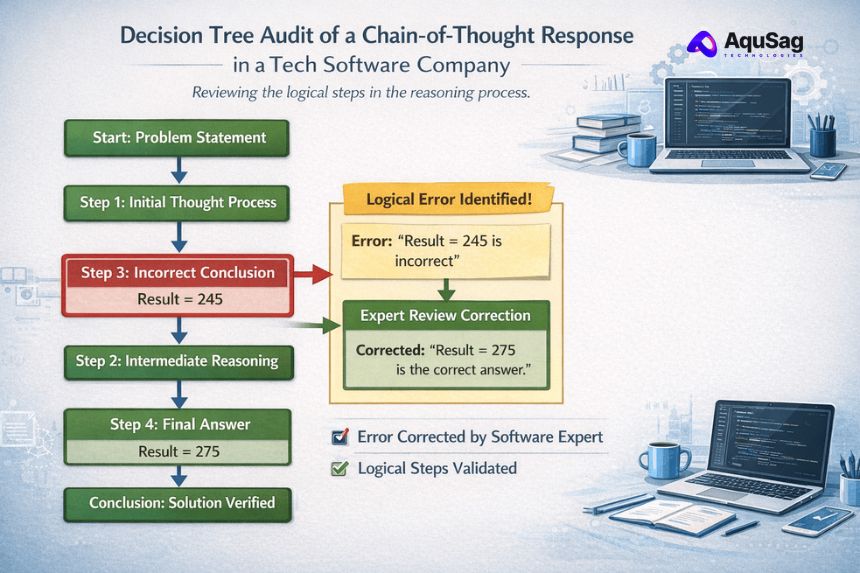
At AquSag Technologies, we have replaced the "Majority Vote" with a Multi-Layer Deterministic Framework. We don't just ask if a label looks right; we prove it is right through a rigorous, expert-led audit trail.
The Architecture of Certainty: Our Four-Layer QA Framework
Standard QA is a single-step check. AquSag’s Deterministic QA is a pipeline. By treating data quality as an engineering problem rather than a clerical task, we ensure that the "Ground Truth" remains indisputable.
Layer 1: The Expert Entry (First-Pass Precision)
Quality starts at the point of origin. Unlike generalist agencies that hire for "speed and volume," our first layer consists of the domain experts we discussed in [The Subject Matter Gap]. A CFA or a PhD in Biology is the one creating the initial data point. Their baseline "incorrect" rate is already orders of magnitude lower than a generalist's.
Layer 2: The Blind Cross-Audit
Once the first expert completes a task, it is routed to a second expert of equal or higher standing for a Blind Audit. The second expert does not see the first expert's work. They perform the task independently. If the two outputs do not match exactly, the system triggers an automatic escalation. This eliminates "confirmation bias," where a reviewer simply skims and approves a previous person's work.
Layer 3: Algorithmic & Heuristic Validation
Human expertise is supplemented by deterministic code. We deploy custom scripts to check for:
- Structural Integrity: Does the JSON or XML output match the schema exactly?
- Logical Consistency: If a financial model says "Revenue increased," do the supporting numbers in the data reflect that increase?
- Linguistic Rigor: We use advanced NLP tools to ensure the tone, syntax, and specialized vocabulary meet the high-bar requirements of the specific industry.
Layer 4: The Lead Researcher Sign-Off
The final 5% of all data, and 100% of edge cases, is reviewed by an AquSag Lead Researcher. This is a senior-level SME who ensures that the data doesn't just meet the technical requirements, but also aligns with the strategic goals of the AI Lab. This layer is crucial for preventing [Model Drift], as it ensures the training data remains representative of the most current industry standards.
Moving from "Good Enough" to "Zero-Defect"
In high-stakes AI applications, such as autonomous diagnostic tools or automated legal compliance, "good enough" is a liability. A single hallucinated fact in a training set can ripple through a model’s weights, leading to unpredictable failures in production.
Data quality in AI is not a spectrum; it is a binary. Data is either Ground Truth, or it is noise.
Our deterministic approach is designed to eliminate the noise. By implementing "Hard Constraints" in our labeling tools, we prevent experts from submitting work that does not meet the pre-defined logical parameters. This "In-Tool Validation" reduces the "Rework Rate" and ensures that our 7-Day Deployment speed does not come at the cost of accuracy.
The Role of Chain-of-Thought (CoT) in Quality Auditing
One of the most complex things to audit is Reasoning. If a model is being trained to solve a multi-step calculus problem, simply checking the final answer is insufficient. The steps must be correct.
Our QA framework for Reasoning Models includes a Step-Wise Audit. We break down the "Chain of Thought" into individual nodes. Our experts verify the transition between Node A and Node B. Is the mathematical transformation valid? Is the logical deduction sound? By auditing the process of thought, we ensure the model learns how to think, not just what to say.
Deterministic QA for RLHF and Alignment
Reinforcement Learning from Human Feedback (RLHF) is often criticized for being subjective. How do you "quantify" if one response is better than another?
At AquSag Technologies, we turn subjectivity into a science through Rubric-Based Ranking. Instead of asking a human "Which do you like more?", we provide a 12-point deterministic rubric:
- Factual Accuracy: Is every claim verifiable?
- Instruction Following: Did the model address every part of the prompt?
- Safety Compliance: Does it adhere to the specific "Guardrails" of the project?
- ...and 9 other industry-specific metrics.
This converts human "feelings" into structured data that a Reward Model can actually use to optimize the LLM.
Interlinking the Ecosystem
To maintain this level of quality at scale, you cannot rely on fragmented freelancers. You need a dedicated, managed structure. This is why our QA framework is built directly into our Managed Pod Model. Each pod has a dedicated QA Lead whose only metric is the "Accuracy Retention Rate" of the data being delivered.
Furthermore, we recognize that quality requirements change as a model evolves. Our Elastic Bench allows us to swap in different types of "Auditor" experts as your model moves from general pre-training to highly specialized fine-tuning.
The Business Value of Precision
Why invest in such a rigorous QA framework? The answer is found in the Total Cost of Ownership (TCO) of an AI model:
- Lower Inference Costs: Accurate models often require fewer "reasoning tokens" to arrive at the right answer.
- Reduced Legal Risk: Zero-defect data is the best defense against AI-generated compliance failures.
- Brand Authority: Models that don't hallucinate build user trust, which is the most valuable currency in the AI era.
Conclusion: Trust, but Verify Deterministically
As we look toward the future of Agentic AI and autonomous systems, the "Subject Matter Gap" will only be closed by those who prioritize precision over volume. AquSag Technologies is committed to providing that precision. Our Deterministic QA Framework is not just a checkbox; it is the core of our philosophy.
We don't just provide data. We provide the Truth that powers your intelligence.
Does Your AI Pass the Quality Test?
If you are seeing inconsistent results from your fine-tuning cycles, the problem likely lies in your QA pipeline. Don't settle for probabilistic data.
Contact AquSag Technologies today to request a "Data Health Audit." Our team of experts will review your current training sets and demonstrate how our Deterministic Framework can elevate your model's performance.