
 As AI advances, the focus has shifted from data volume to data quality and expert alignment. Early LLMs relied on massive, unfiltered datasets, which led to diminishing returns, bias propagation, and costly alignment issues. Today, curated, domain-specific datasets drive superior outcomes—something we also explored in detail in our guide on optimizing LLM training data in 2026
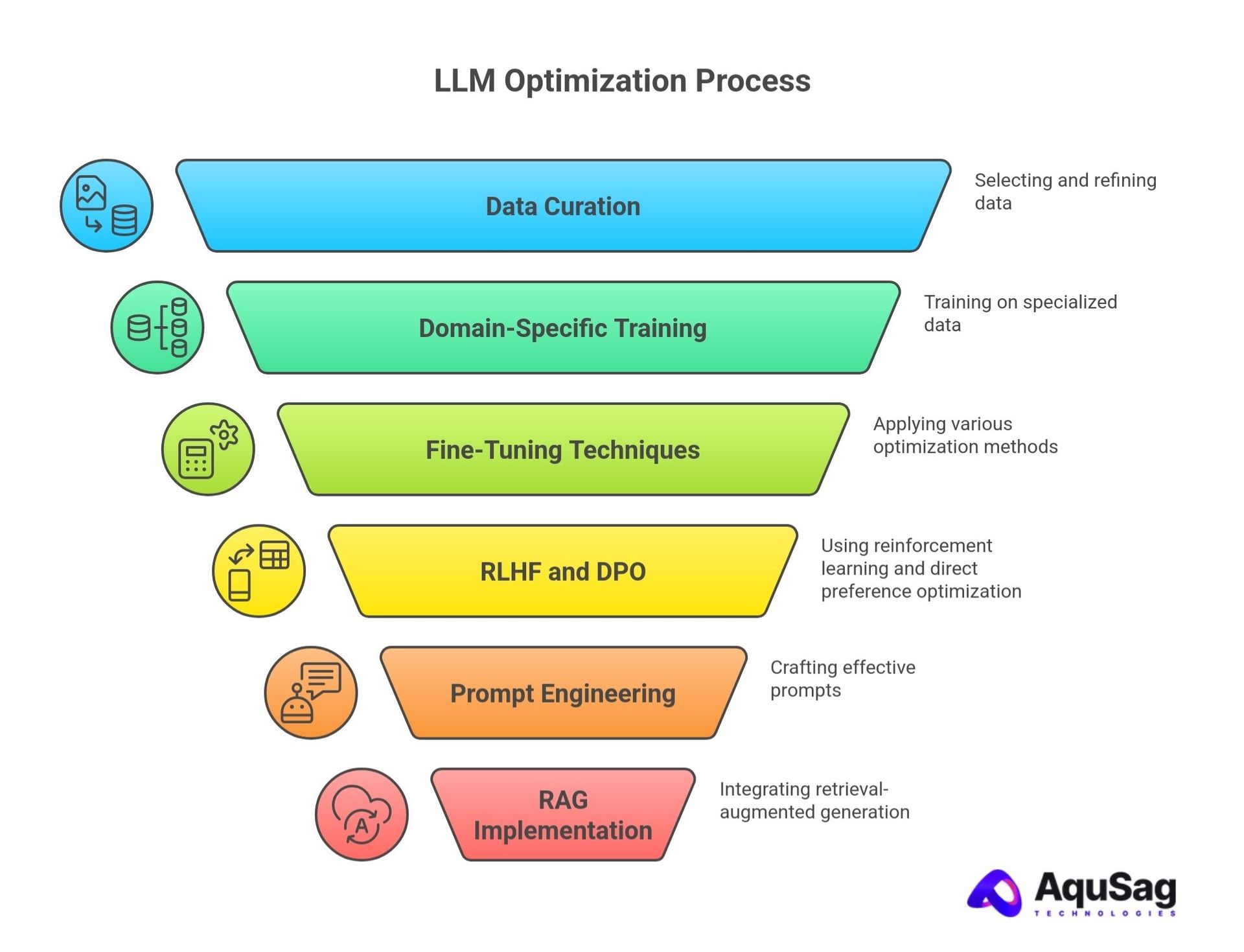
At Aqusag.com, we provide specialized LLM trainer services across agentic workflows, finance, psychology, and multilingual domains. This article examines essential techniques—supervised fine-tuning, instruction tuning, RLHF, DPO, prompt engineering, RAG, and red teaming—that transform foundation models into production-ready solutions.
The Data Quality Imperative
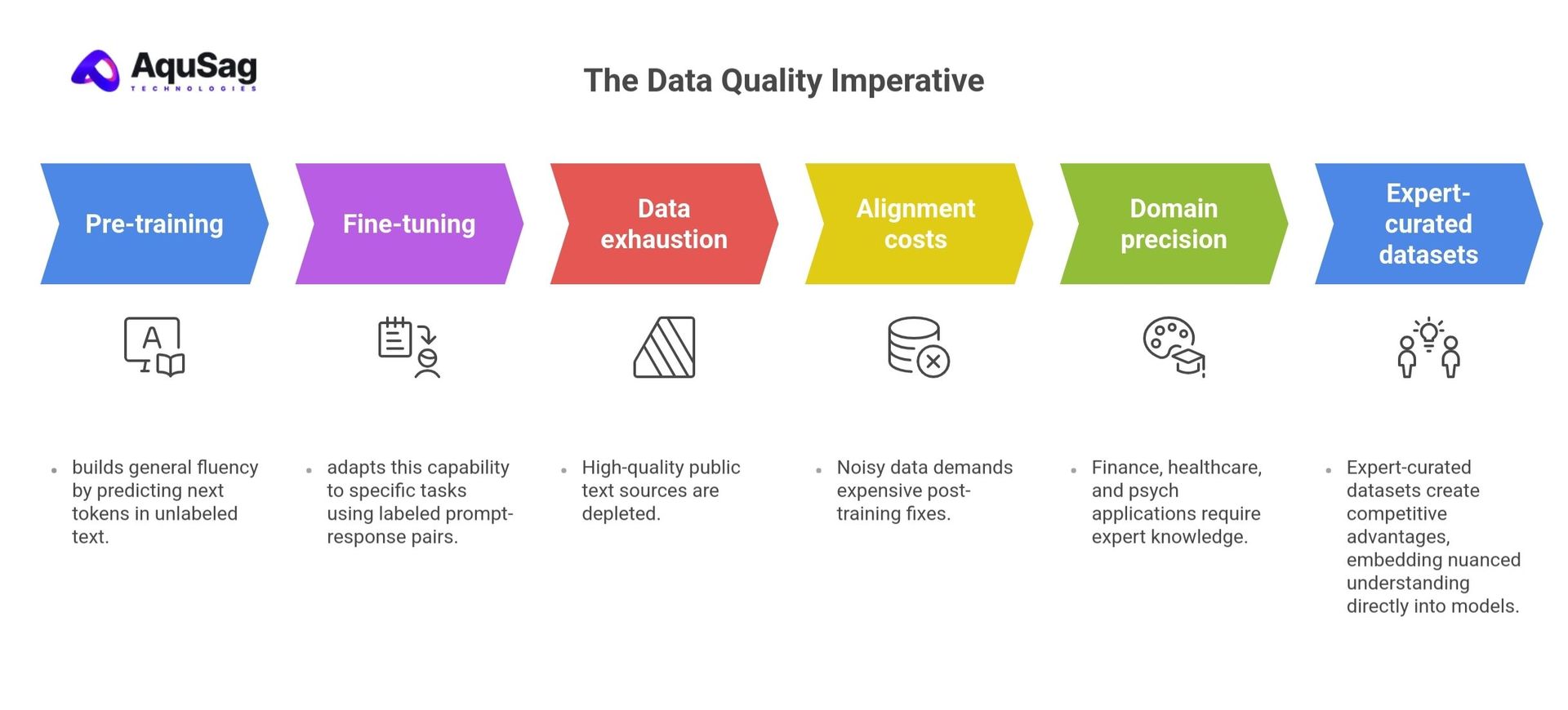
Pre-training builds general fluency by predicting next tokens in unlabeled text. Fine-tuning adapts this capability to specific tasks using labeled prompt-response pairs.
Why quality matters:
- Data exhaustion: High-quality public text sources are depleted
- Alignment costs: Noisy data demands expensive post-training fixes
- Domain precision: Finance, healthcare, and psych applications require expert knowledge
This is why many enterprises now partner with external AI workforce specialists rather than building everything in-house—a decision framework we outline in what an AI workforce partner should actually deliver
Core Fine-Tuning Techniques
Supervised Fine-Tuning (SFT)
Adapts pre-trained models to task-specific datasets:
Pre-training: "The sun rises in the..." → "east"
Fine-tuning: "Travel from NY to Singapore" → "Flight routes, visas, layovers"
Applications include financial analysis, legal review, diagnostics, and domain chatbots. Scaling SFT efficiently often requires dedicated trainer pools—a challenge addressed in how high-growth AI companies scale LLM teams without expanding internal headcount
Instruction Tuning
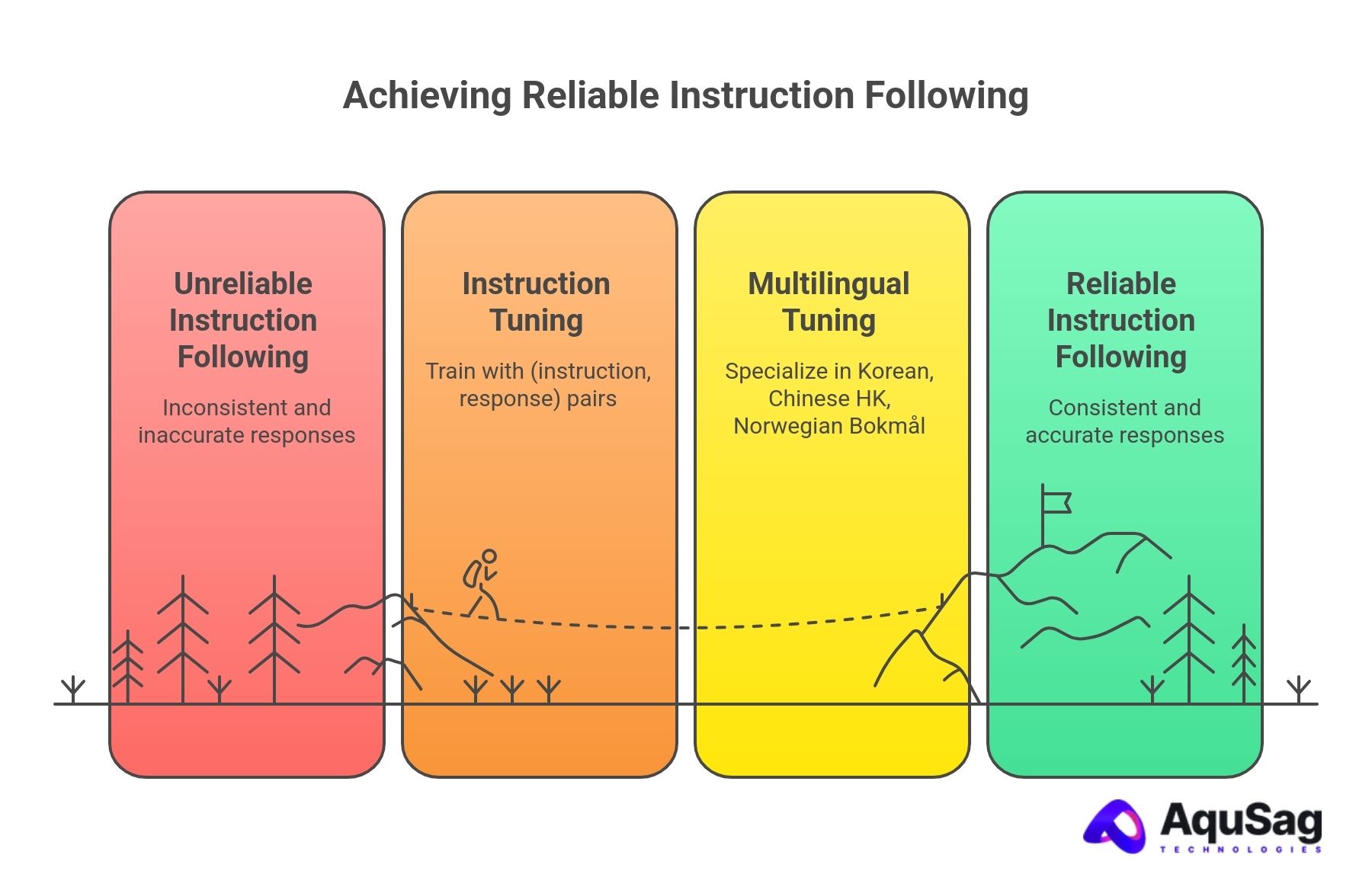
Teaches reliable instruction-following using (instruction, response) pairs:
- Summarization: "Summarize this EHR record"
- Translation: "Translate to Italian"
- Formatting: Structured financial reports
Aqusag.com specialty: Multilingual instruction tuning (Korean, Chinese HK, Norwegian Bokmål)
Advanced Alignment Methods
RLHF: Reinforcement Learning from Human Feedback
Aligns models with complex human preferences:
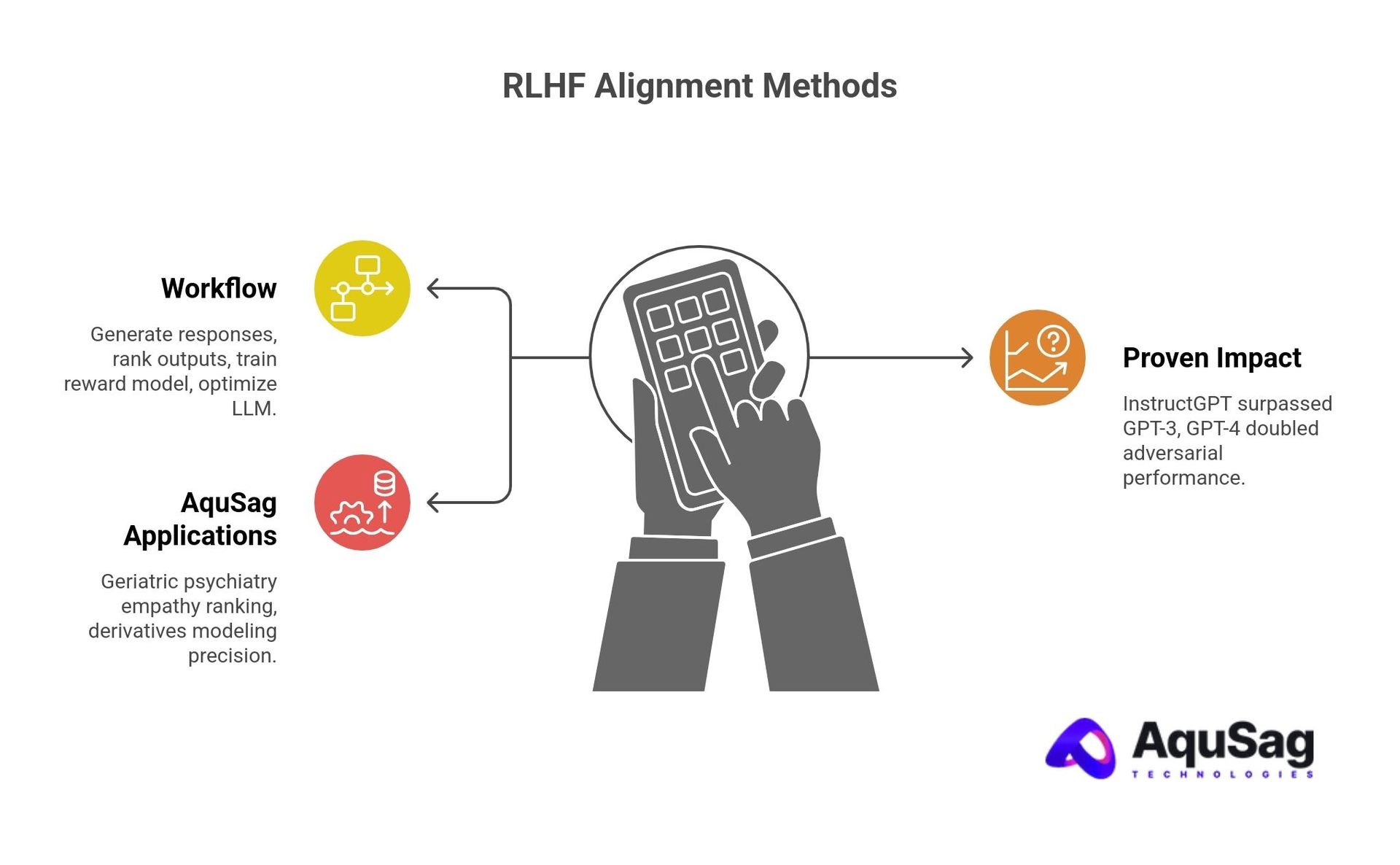
Workflow:
- Generate multiple responses per prompt
- Expert annotators rank outputs (best → worst)
- Train reward model on rankings
- Optimize LLM via reinforcement learning (PPO)
Its operational complexity often pushes companies to seek external delivery models, as detailed in how enterprises build RLHF and GenAI pipelines without specialized internal teams
For a deeper technical breakdown, see The complete guide to RLHF for modern LLMs.
DPO: Direct Preference Optimization
Streamlined RLHF alternative using preference pairs (prompt, preferred, rejected):
Advantages:
- No reward model training
- Stable optimization
- Compute-efficient
- Matches RLHF performance
Ideal for rapid iteration across our 20+ finance and psych trainer specializations.
Lightweight Optimization Strategies
Prompt Engineering
Shapes outputs without retraining:
Technique |
Use Case |
Example |
|---|---|---|
Zero-shot |
Simple classification |
"Analyze sentiment" |
Few-shot |
Pattern matching |
2-3 input/output examples |
Chain-of-Thought |
Complex reasoning |
"Think step-by-step" |
RAG: Retrieval-Augmented Generation
RAG vs Fine-tuning:
RAG |
Fine-tuning |
|
|---|---|---|
Knowledge |
Dynamic retrieval |
Static training data |
Cost |
Query-time |
Full retraini |
Use case |
Proprietary data |
Deep specialization |
Safety & Reliability: Red Teaming
Production LLMs must withstand adversarial attacks:
Attack vectors:
- Prompt injection: "Ignore safety rules"
- Jailbreaking: Role-play bypasses
- Bias amplification: Embedded training data flaws
Red teaming workflow:
- Craft adversarial prompts
- Document failures
- Generate corrective training data
- Realign model
Aqusag.com red team: 24 domain-specialized teams probing finance, psych, and agentic vulnerabilities.

Aqusag.com's Production LLM Services
Expertise across 30+ domains:
Finance ($80-200/hr):
• Debt Capital Markets • Derivatives & Quant
• Project Finance • Structured Finance
• Energy & Renewables • Healthcare Finance
Psychology ($100-200/hr)
• Geriatric Psychiatry • Forensic Psychology
• Sexual Health • Well-being Specialists
Technical:
• Agent Function Calling • ServiceNow Integration
• Pascal/Delphi • Multilingual (7 languages)
Complete workflow:
- Custom dataset curation
- RLHF preference ranking
- Hallucination detection
- Instruction design
- Model benchmarking
- Red teaming & safety
2026 Performance Benchmarks
Technique           | Performance Gain | Cost Reduction
--------------------|------------------|---------------
Expert Data Curation| 25-35% accuracy  | - [attached_file:1]
RLHF Alignment      | 2x adversarial   | - [attached_file:1]
DPO Optimization    | RLHF equivalent  | 40% compute [attached_file:1]
RAG Implementation  | Real-time facts  | 80% vs retrain [attached_file:1]
Red Teaming         | Safety +15%      | - [attached_file:1]
Implementation Roadmap
Phase 1: Foundation
1. Select base model (DataCamp/Zapier rankings)
2. Curate domain dataset (100-10K examples)
3. SFT + instruction tuning
Phase 2: Alignment
4. RLHF/DPO preference loops
5. Prompt engineering optimization
6. RAG pipeline integration
Phase 3: Production
7. Red teaming & safety audit
8. Benchmarking suite
9. Deployment monitoring
10. Continuous iteration
Conclusion
The LLM era has matured beyond scale. Quality data + expert alignment = production success. Aqusag.com delivers complete training pipelines—from agentic function calling to specialized finance and psychology expertise.
Contact our specialists to optimize your LLM development.